
‘Supergraft’ reconstructs bone and fights infections simultaneously
08 de setembro de 2026By Roseli Andrion | FAPESP Innovative R&D – One of the greatest challenges in treating severe fractures is reconstructing damaged bone tissue while preventing bacterial infections. BioActive Biomateriais, a startup headquartered in Indaiatuba in the state of São Paulo, Brazil, has developed a solution to this problem. With support from FAPESP, the company’s engineers created a smart graft that functions as a temporary “scaffold.” The product provides the necessary structure for cells to attach to and grow, while also actively fighting infections.
The secret to its effectiveness lies in its three-phase formulation. By combining three distinct materials – calcium sulfate, hydroxyapatite, and tricalcium phosphate – the startup has created an optimized solution for bone regeneration. The mixture was designed so that calcium sulfate dissolves quickly to make room for new cells during regeneration, while the other two components degrade more slowly to ensure firm support over time.
In addition to structural reconstruction, the graft combats diseases such as osteomyelitis, a bone infection that often makes orthopedic treatments slow and painful. To provide this protection, the company incorporated three metal ions – silver, zinc, and strontium – into the material, each serving a specific function. Silver and zinc inhibit bacterial proliferation, and strontium stimulates the cells that build bone (osteoblasts) while inhibiting those that destroy bone tissue (osteoclasts).
“The idea of combining three functional compounds with antimicrobial ions is unprecedented in the biomaterials market,” Karen Grancianinov, the chemical engineer in charge of the project, told Innovative R&D. She explained that, although academic studies have explored similar formulas, BioActive is the first to transform this scientific knowledge into a viable commercial product.
Unlike conventional products, which act only as passive fillers, the new technology offers integrated properties. As the researcher explains, the material is biocompatible (accepted by the body without rejection), bioresorbable (absorbed by the body as the bone grows), and osteoconductive (serves as a structural guide for new tissue).
Practicality in the operating room
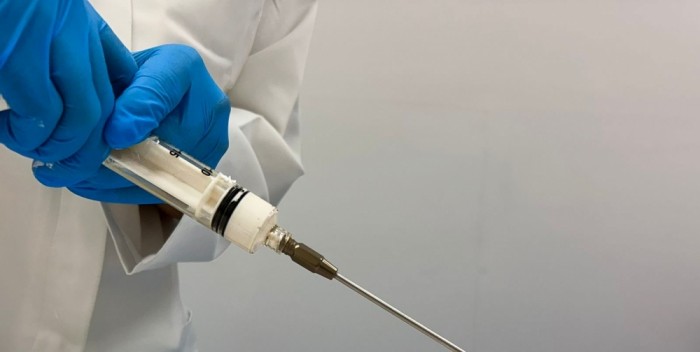
Another strength of this technology is its versatility. The material comes in powder form. When mixed with a liquid during surgery, it transforms into a moldable paste similar to cement. This consistency enables surgeons to inject the solution into small fissures or shape it to fill extensive bone defects in the arms, legs, and dental implants.
Typically, surgeons resort to an “autograft,” which involves removing bone from the patient’s own body. This painful procedure requires a second surgical site and increases risks. In other countries, “allografts” (donor bone) are used. However, since this practice is prohibited in Brazil, BioActive’s innovation emerges as a cutting-edge technological alternative that fills this gap in the domestic market.
“The versatility of the graft eliminates the need for other surgical procedures in many cases, reducing risks and recovery time,” Grancianinov notes.
The product is in the initial testing phase in animal models. The next step is to conduct a clinical trial in humans, which requires approval from Brazil’s Health Regulatory Agency (ANVISA), which is responsible for authorizing subsequent commercialization.
Technological independence
In addition to the clinical benefits, developing this technology – funded by FAPESP’s Innovative Research in Small Businesses Program (PIPE https://bv.fapesp.br/en/266) –helps reduce the country’s technological dependence. Currently, most grafts used in Brazil are imported, leaving hospitals vulnerable to exchange rate fluctuations. According to Felipe Bisson, the commercial director at BioActive, domestic investment is a long-term strategy.
“We could have brought in a ready-made solution from abroad, but we chose to develop it here to create something unique. The goal is to serve as a bridge between the university and industry,” says Bisson.
Looking ahead, the goal is to incorporate the graft into the SUS (the “Sistema Único de Saúde,” Brazil’s national public health network), which is a crucial step in light of the aging population and the rise in chronic diseases requiring bone regeneration. “The aging population increases the demand for regenerative treatments. As professionals come to understand the specific characteristics of each material, the market grows,” says Bisson.
However, the transition from the laboratory bench to the operating room requires extreme precision. Currently, the BioActive team is working on scaling up from the laboratory to industrial production. “Academic and industrial development proceed at different paces,” Grancianinov notes, pointing out that adapting production from a few grams of material to hundreds of kilograms is an ongoing technical challenge.
With the global biomaterials sector projected to exceed USD 200 billion by 2033, BioActive is looking beyond Brazil’s borders with plans to expand to Latin America, Asia, and Europe. Although regulatory approvals are still pending, the startup continues to invest in continuing education for physicians. They emphasize that the technology has a clear purpose for patients: to regain autonomy and return to a pain-free life.