
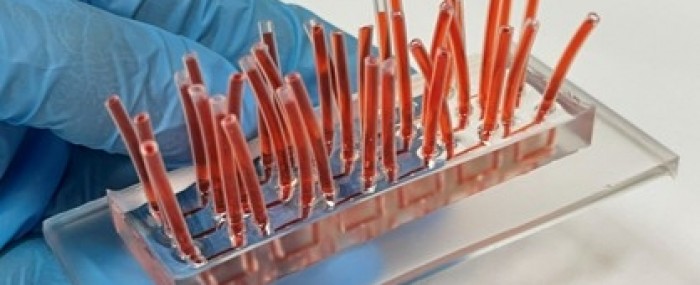
Device simulates human tissue and offers an alternative to animal testing
01 de setembro de 2026FAPESP Innovative R&D – Researchers at the Brazilian Center for Research in Energy and Materials (CNPEM) have developed microscopic technology that can grow cells in three dimensions (3D). The goal is to conduct toxicity tests on new products by more accurately simulating living organisms.
This technology is a breakthrough for drug development, material safety assessment, and ecotoxicology research (the study of the impact of substances on ecosystems). It also helps reduce the need for animal testing. The device uses microfluidics, which allows for precise control of the flow of nutrients, oxygen, and other substances in microscopic tests. This maintains three-dimensional cellular models that more closely resemble the structure and function of human tissues. Compared to conventional cell cultures grown on flat surfaces, 3D models provide better insight into the effects of drugs, nanomaterials, and environmental pollutants.
The platform is manufactured from PDMS, a malleable, transparent, biocompatible, and low-cost silicone, and enables the automated conduct of multiple experiments. One of its key features is its reversible design, which allows the device to be opened after testing to retrieve intact cellular models for further analysis. This expands the possibilities for investigating the mechanisms of action of the substances being evaluated.
The study was published in July in the scientific journal ACS Measurement Science Au. It was conducted within the scope of the Research Center for Molecular Engineering of Advanced Materials (CEMol), a Research, Innovation, and Dissemination Center (RIDC) funded by FAPESP at the CNPEM.
The study presents three main advances. First, it developed a standardized, reproducible, and user-friendly experimental protocol that enables researchers without prior microfluidics experience to use the technology in routine cell assays. Second, the ability to recover three-dimensional cell models for further analysis after testing is a key feature. This capability, uncommon in microfluidic platforms, allows for a more in-depth investigation of how drugs and materials interact with cells. Third, the ability to conduct assays under continuous flow conditions more accurately replicates the circulation of nutrients and molecules observed in the body.
Consequently, results obtained in the laboratory more accurately reflect the behavior of substances in real biological systems. “We’ve developed a simple and reproducible protocol that will allow researchers from different fields to use the platform. Furthermore, the ability to recover the cell models after the assays significantly expands the range of analyses that can be performed,” Iris Renata Sousa Ribeiro, a postdoctoral researcher affiliated with the Brazilian Nanotechnology Laboratory (LNNano-CNPEM) and the first author of the study, explains to the CNPEM Press Office.
The team is working to make the platform available as an open infrastructure for external researchers from universities, research institutes, and companies by early next year. They aim to expand its use in pharmacology, nanotechnology, materials science, biotechnology, and ecotoxicology studies. “We want researchers from across the country to be able to use this technology to develop more accurate toxicity assays that closely resemble actual conditions in living organisms,” Ribeiro says.
The work was also supported by FAPESP through projects 22/02378-0, 23/00246-1, 24/14758-7, 25/22142-9, 25/00614-6, 25/22280-2, and 25/26623-1.
The article “Reversible microfluidic platform for spheroid culturing, downstream characterization, and dynamic anticancer susceptibility testing” can be found at pubs.acs.org/doi/10.1021/acsmeasuresciau.6c00140.