
Startup uses algorithms and genetics to boost profits from animal protein sales
04 de agosto de 2026By Roseli Andrion | FAPESP Innovative R&D – Just like humans, farm animals such as cattle, poultry, and fish have unique metabolisms, physiologies, and genetics that dictate their weight gain rates. Consequently, some animals gain weight faster than others under the same rearing system, reducing the productivity of the sector.
To help farmers convert this biological variability into economic predictability, the Brazilian startup @Tech has developed an artificial intelligence platform that forecasts the optimal time to market animals, providing a head start of several weeks.
The platform estimates how much money an animal can generate if it remains on the farm, explains Marcos Iguma, an agricultural engineer and the director of operations at @Tech. “Based on the data generated on the farms, it’s possible to increase the operation’s profit even before a batch is sent to the slaughterhouse,” the researcher tells Innovative R&D.
Supported by FAPESP’s Innovative Research in Small Businesses (PIPE) program and the Brazilian Association for Industrial Development (ABDI), the project combines animal science, economics, genetics, artificial intelligence, big data, and computer vision.
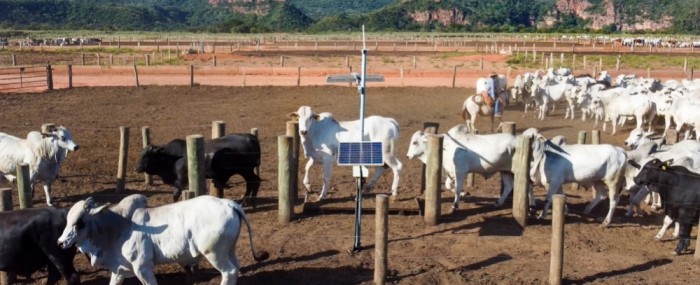
The research began in the laboratories of the Luiz de Queiroz College of Agriculture (ESALQ) at the University of São Paulo (USP), where the startup was founded in 2013. The first solution developed was the Beef Trader platform. The system uses data from scales installed at strategic points along the animals’ movement routes in feedlots. These scales record the animals’ weight as they approach the feed or water troughs without affecting their behavior, since the process involves no human intervention or stressful handling.
This data is combined with individual zootechnical information and real-time economic indicators, such as the price per arroba (equivalent to 15 kilograms). Based on this information, the tool projects the herd’s future performance and calculates various marketing strategies. “For example, it can estimate the profit if all the animals were sold on the same day and how much that amount could increase if the herd were split into different sales dates,” Iguma explains.
This management practice, known as “batch thinning,” involves the early removal of steers with low feed conversion rates, thereby reducing feed costs. In tests conducted by the company, this strategy increased the profitability of beef cattle production by up to 30%. “The key advantage isn’t tracking the animals’ growth, but rather, bringing forward decisions that typically depend on the producer’s experience,” Iguma notes.
By culling the least efficient animals first, producers reduce expenses on the most costly aspect of the operation and keep only the animals with economic potential in the finishing phase. Meanwhile, high-performing animals have more time to reach their highest market value on the farm.
The DNA of profitability
In parallel with this work, researchers at the startup have refined an indicator widely used in genetic improvement programs: the expected progeny difference (EPD). While traditional EPDs evaluate traits such as weight gain, maternal ability, and fertility, @Tech’s methodology combines animal performance information with genomic prediction analyses to anticipate the profitability potential passed on by bulls and breeding cows to their offspring.
Using DNA obtained from samples of the animal’s tail hair, the platform identifies genetic combinations directly linked to financial returns. Through this process, the researchers have identified specific regions of DNA associated with genetic traits that generate economic profitability.
As a result, it is possible to estimate profit potential for any animal, even during the finishing phase. According to the company’s researchers, this is a unique solution worldwide. The technology is already being used with different beef cattle breeds, as well as Zebu cattle used for meat production and, more recently, dairy cattle.
In animal protein production, feed accounts for more than 70% of costs. Since fixed farm expenses, such as employee salaries and electricity bills, exist regardless of herd performance, producers’ actual profits depend directly on the cattle’s biological efficiency. “By identifying early on which animals have lost efficiency, the producer avoids spending resources on those that have already reached their peak performance,” Iguma explains.
According to data from the Brazilian Institute of Geography and Statistics (IBGE), approximately 32 million head of cattle and 6 billion chickens are slaughtered in Brazil each year. In this context, saving a few kilograms of feed per animal can translate into millions of Brazilian reais (BRL) in savings across the production chain. Thus, closely monitoring feed conversion – that is, how much the animal eats and how much of that feed it actually converts into meat – is key to ensuring the profitability of the herd.
New markets
According to IBGE data, Brazil has the world’s largest commercial cattle herd and is a leading producer and exporter of beef and chicken. “Making better use of natural resources in animal protein production is a necessity in light of growing global demand for food,” Iguma notes.
This insight led @Tech to expand its research into poultry farming. The algorithms crossed the fences of cattle ranching and reached poultry farms with Poultry Trader. While cattle can be monitored individually, it is impractical to identify chickens individually – a single poultry house houses tens of thousands of birds at a time.
The software integrates with agribusiness databases, which contain information on sample weigh-ins and the volumes of feed and water supplied to the animals. Based on this data, the system indicates the optimal time to send the birds to slaughter, maximizing the profitability of the process and optimizing logistics. Currently, around 400 São Salvador Alimentos poultry farms use the technology developed by @Tech.
More recently, the startup launched a commercial pilot project for fish farming called Fish Trader. This technology uses underwater sensors and computer vision techniques to overcome the main obstacle of collecting biometric data from native fish. This method eliminates the need to remove fish from the water for weighing and measuring, activities that increase stress in the animals, impair feed conversion rates, and alter vital parameters such as temperature and pH in the aquatic environment.
Environmental indicators
In addition to providing direct financial gains, controlling the fattening process is beneficial for sustainability. According to the Food and Agriculture Organization of the United Nations (FAO), livestock farming accounts for approximately 14.5% of global anthropogenic greenhouse gas emissions, underscoring the importance of technologies that promote efficient resource use.
The @Tech platform generates environmental indicators, including estimates of water consumption, waste production, and greenhouse gas emissions equivalents – information that is in high demand from meatpackers, investors, and international buyers. With clients in Brazil, Paraguay, and Bolivia, the startup believes that evidence-based decisions can increase profitability and the efficiency of animal production simultaneously.
The tool provides environmental indicators and addresses requirements that are increasingly prevalent in international markets. It can also help producers track efficiency and emissions-related goals. @Tech already has governance structures in place in the United States and is exploring opportunities in Australia. The company plans to bring its technologies to these markets. “That’s the role of scientific research: to transform knowledge into solutions that reach the field and help producers make better decisions,” Iguma summarizes.