
Brazilian startup aims to manufacture custom-made human organs
23 de junho de 2026By Roseli Andrion | FAPESP Innovative R&D – It is the year 2050. In Brazil, a surgeon logs into the system of a hospital affiliated with the SUS (the national public health system) and selects a three-dimensional model of a heart whose measurements match those of a patient on the transplant waiting list. Next, a 3D printer deposits living human cells, layer by layer, until the designed organ takes shape. This procedure eliminates waiting lists, the need for donors, and the risk of rejection since the heart is manufactured from the recipient’s own cells.
This scene may seem like something out of a science fiction movie, but the necessary science is already being developed in the laboratories of TissueLabs, a startup supported by FAPESP’s Innovative Research in Small Businesses Program (PIPE). Currently, the team produces tissue fragments measuring a few centimeters for research, drug testing, and developing disease models. The goal is to have the first tissues approved for clinical use within ten years. The vision for 2050 has the potential to rewrite the history of medicine.
Founded in São Paulo in 2019 and now headquartered in Switzerland, the company uses biomaterials that act as “biological cement” for cells. “If an organ were a building, the cells would be the bricks, and our biomaterial would be the cement that binds them together,” explains Gabriel Liguori, founder and CEO of the startup.
A key feature of TissueLabs’ biomaterials is that they are tissue-specific. This means that a material derived from the extracellular matrix of that specific tissue is used for each structure to be reproduced. The extracellular matrix is the supportive structure surrounding the cells and dictates how they organize, communicate, and specialize. Currently, the company has over 45 formulations for more than 15 tissues, including heart, liver, kidney, pancreas, skin, cartilage, bone, and brain.
The method of solidification can affect the formulation. Some formulations are photocrosslinkable, meaning they harden when exposed to light. Others are crosslinkable through chemical or thermal means. This flexibility expands the range of applications for different 3D printing technologies.
One such technology is 3D bioprinting, which involves manufacturing biological structures layer by layer using cells and biomaterials. This process gives tissues their three-dimensional form. It begins with stem cells, which can differentiate into various cell types.
At TissueLabs, induced pluripotent stem cells (iPSCs) are used. Unlike embryonic stem cells, iPSCs are obtained from adult tissues, such as from skin biopsies or blood samples. In the laboratory, the cells are “reprogrammed” to resemble embryonic cells. They are then differentiated into the desired cell type. For example, they can become cardiomyocytes, which are responsible for the contraction and relaxation of the heart, or hepatocytes, which are the main cells of the liver.
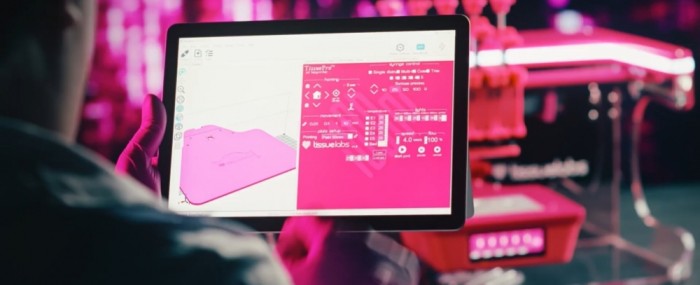
Once a sufficient number of cells have been obtained, they are mixed with the biomaterial and loaded into a 3D printer developed specifically for this purpose. The result is a three-dimensional, layered tissue that mimics the natural architecture of the original tissue in the human body. The startup has three printer models on the market and has over 300 institutions in 30 countries using its biomanufacturing platform.
Currently, the tissues produced by TissueLabs are intended exclusively for laboratory settings. Clients include academic researchers, pharmaceutical companies, and cosmetics firms. For example, L’Oréal uses the TissueLabs platform to 3D-print skin, replacing the use of animals in product testing. This initiative was announced at the Viva Technology 2024 trade show in Paris.
Potential markets
The global 3D bioprinting market was valued at around USD 2.6 billion in 2024. The consulting firm Towards Healthcare projects it will reach USD 8.5 billion by 2034, growing at an annual rate of about 12.5%. The tissue and organ generation segment is the fastest-growing.
In the pharmaceutical sector, this technology has strategic applications. According to an article published in the scientific journal Acta Pharmaceutica Sinica B, developing a new drug costs, on average, between USD 1 billion and USD 2 billion, with a development timeline of 10 to 15 years. Despite this significant investment, nine out of ten drug candidates fail in clinical trials, and toxicity accounts for 90% of these failures. Cardiac toxicity is the leading reason for discontinuation, accounting for 30% of cases.
Studies published in the journal Arteriosclerosis, Thrombosis, and Vascular Biology indicate that approximately 30% of drugs abandoned in clinical trials between 2011 and 2012 were discontinued due to cardiovascular safety concerns. Furthermore, research published on the ScienceDirect platform shows that cardiovascular problems account for 45% of drug recalls after approval.
In this context, TissueLabs is developing its own cardiotoxicity testing platform. The goal is to provide pharmaceutical companies and contract research organizations (CROs) with a tool to determine if a new drug is harmful to the heart before it enters human trials. “We can reduce development costs and, more importantly, the risk to patients,” Liguori notes. The platform is expected to launch commercially within the next two years.
Organs for transplantation
The long-term goal remains ambitious: manufacturing organs for transplantation. Liguori estimates that the first clinically approved tissues, such as blood vessels and heart valves, will be commercially available in about ten years.
The timeline for whole organs is longer. While a functional prototype could be ready around 2040, the rigorous process of clinical trials and regulatory approval is expected to take at least another decade. “It’s important to avoid false expectations. Even with a prototype ready, it’ll take years to complete the clinical trials,” Liguori points out. “Naturally, it’ll still require a great deal of development.”
According to the researcher, the regulatory landscape varies globally. “Japan has a system that allows the process to be accelerated, while other countries are slower.” Investment and persistence are needed, but science has already paved the way for 3D printing a heart. The next challenge is essentially a matter of engineering and time.
Personal motivation
Even before enrolling at the University of São Paulo Medical School (FM-USP), Liguori was attending the institution’s Heart Institute (InCor). Born with a congenital heart defect, he has been under the Institute’s care since he was seven days old. Seeking solutions in this field became second nature. “I remember always saying I’d become a doctor,” he says.
Interested in cardiovascular surgery, he discovered tissue engineering and incorporated it into his career path. “In 2014, during my senior year of college, I realized that this field practically didn’t exist in Brazil. I decided to study abroad and bring that knowledge back.”
After earning his Ph.D. from the University of Groningen in the Netherlands, he returned to Brazil, where he worked as a researcher at InCor and set up a tissue engineering laboratory. However, he soon realized that he needed to dedicate himself exclusively to the project. In 2019, he founded TissueLabs with his partner, engineer Emerson Moretto.
The company expanded internationally in 2021 with the opening of a distribution office in Switzerland. Due to logistical issues, the biological research also moved to the European country two years later. Reagents that arrive in Europe in two days take months to be cleared in Brazil. “Even with the necessary resources, the availability here isn’t the same as it is abroad,” says Liguori. The company’s printer development and manufacturing operations remained in Brazil.
Although the Brazilian market accounts for less than 10% of TissueLabs’ revenue, the company maintains its market leadership in the country. The goal is to grow the team of 12 to 20 by the end of the year. The startup has a 3 million Swiss franc (about USD 3.5 million) investment round currently open, with a target closing date of June 2026.