
Data intelligence predicts water shortages in rural areas
09 de junho de 2026By Roseli Andrion | FAPESP Innovative R&D – Even before sunrise, farmers are faced with a grueling dilemma. The crops are crying out for water, but activating the system requires a sacrifice. They must travel miles to the pump house with no guarantee that the river will have enough water to sustain the operation. It is a blind and lonely journey in which the risk of discovering too late that the water source will not meet the demand consumes precious time and resources.
Spectrum, a São Paulo-based startup supported by FAPESP’s Innovative Research in Small Businesses Program (PIPE), has developed a solution to help farmers deal with situations like this. They expanded the use of an Internet of Things (IoT) platform called PalmaFlex, which they launched in 2019 to monitor soil moisture. Adilson Chinatto and Cynthia Junqueira developed the system. Junqueira is an electrical engineer with a master’s degree from the Technological Institute of Aeronautics (ITA) and a doctorate from the State University of Campinas (UNICAMP).
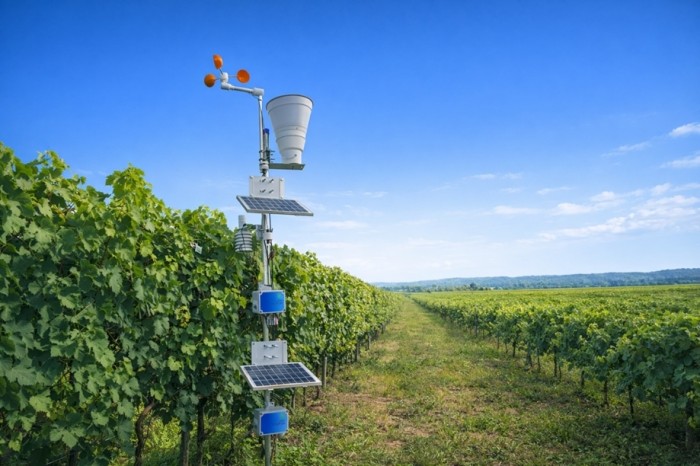
The new system, called PalmaFlex Total, transforms scattered measurements into practical information. It combines ground-based sensors and long-range radio data communication capable of covering areas of up to 3,000 hectares with artificial intelligence models to estimate water availability. It is a robust solution with low maintenance costs and high connectivity in remote areas.
The platform allows users to monitor variables such as wind, solar radiation, and temperature, as well as detect engine failures.
Focus on water sources
Natural sources of water include springs, streams, creeks, and rivers. On large grain-producing farms, the intake point is typically a smaller tributary that loses flow quickly during dry months, depending on rainfall patterns.
Most large farms use a center pivot system, which requires constant pressure from the pump in order to irrigate large, circular areas. When flow is insufficient, the equipment may shut off automatically because it fails to reach the minimum pressure. “That’s more than just a waste of time. Irregular irrigation hinders crop development,” explains Chinatto. In crops like soybeans and corn, failures at critical moments can jeopardize the entire harvest.
With Spectrum’s tool, the professional responsible for irrigation decisions receives a flow forecast. The platform indicates whether there is enough water to operate the system or if it is better to wait, taking into account factors such as the rainfall forecast in the headwaters of the basin.
This predictive capability influences strategic decisions such as the ideal time to turn on pivot systems, the feasibility of investing in new reservoirs, adjusting the planting window, and choosing crops that are less dependent on irrigation. “It’s a data-driven strategy similar to the one producers already use for rainfall,” notes Junqueira.
The second function of the technology involves analyzing public rainfall data from the upstream watershed (the upper region of the basin responsible for feeding the river) and cross-referencing it with satellite imagery and weather forecasts. Since this elevated area dictates the flow, the rainfall volume recorded there directly impacts the downstream flow – where the water intake system is located – days in advance.
Based on this, the system provides up to 16 days of forecasting, enabling producers to schedule irrigation with precision. The expectation is to extend this timeframe as the models evolve.
This information enables the calculation of the water balance, which is the difference between the water that enters (rainfall and irrigation) and the water that leaves (evapotranspiration). This calculation is essential for determining precise crop management.
Real results
Junqueira also emphasizes the value of the tool for renewing water permits, which are government authorizations for water use that must be renewed every five years. Historical flow data recorded in PalmaFlex Total provides critical evidence for negotiations regarding a property’s actual water availability.
Additionally, the data improves the image of irrigated agriculture. Although the sector is often blamed for water depletion, farms with conservation practices can actually increase aquifer infiltration and recharge. “There are properties that, thanks to these techniques, act as water generators,” says Chinatto. The platform documents this phenomenon, paving the way for environmental incentive applications.
Accelerated expansion
“The potential is vast, especially in the face of climate change,” says Chinatto. Rainfall patterns have become more irregular, with prolonged droughts interspersed with extreme weather events.
The project also has urban applications. The same logic can be used by Civil Defense to monitor small rivers running through cities, anticipate floods, and issue early warnings. Thus, technology developed to ensure food security in rural areas is now poised to protect urban areas as well.