
Graphene ‘scaffold’ recruits bone cells and helps the body regenerate fractures
24 de março de 2026By Reinaldo José Lopes | FAPESP Innovative R&D – Experiments conducted in Brazil using laboratory rats have shown that graphene-based structures can act as a powerful ally in bone regeneration. These structures are made of sheets of the chemical element carbon that are just one atom thick. They can help heal fractures or bone loss. In the tests, the biocompatible matrix containing graphene facilitated nearly 90% repair of the damage sustained by the test subjects one month after the fracture was induced in the laboratory – a superior performance to that of other materials used in the research.
The analysis of the performance of the biomaterial was published in the journal Scientific Reports. Daniela Franco Bueno of the Albert Einstein Israeli Faculty of Health Sciences and Guilherme Lenz e Silva of the Engineering School of the University of São Paulo (POLI-USP) coordinated the study.
According to Bueno, these results provide a strong indication that this approach will soon be used on human patients. “This technology is in an advanced stage of preclinical development,” she summarizes. “There’s a clear path toward application in clinical trials in the next steps.”
The team used black liquor, a byproduct of the pulp and paper industry containing dissolved wood residues and other organic molecules, as the raw material for the experiments. Black liquor is a dark solution, hence the name.
Carbon obtained from processing black liquor has been combined with various nanoscale materials (on the order of billionths of a meter), including graphene itself, graphene oxide, and nanographite. The latest addition is chitosan-xanthan-based polymers, which are complex organic molecules derived from crustaceans and bacteria, respectively.
According to Bueno, biomaterials like these do not behave like inert, permanent prostheses such as those made of metal. However, they are not simply reabsorbed by the body like some biodegradable polymers.
“In the context of tissue engineering, these materials primarily act as bioactive scaffolds,” she says. “They’re temporary structures that guide, stimulate, and accelerate bone tissue regeneration. In the medium and long term, what happens is not passive permanence of the material but rather dynamic interaction with the body.”
The exact shape of the carbon structures, the size of the particles, and the combination with other materials are all factors that influence this interaction. These factors influence the relationship between the biomaterial and the cells in the body, such as macrophages (defense cells), osteoclasts (which resorb bone structures), and stem cells (which give rise to various cellular structures). Depending on the case, the material can degrade or be remodeled and gradually replaced by new bone tissue formation. Alternatively, it can remain in residual amounts without causing inflammation and act as structural reinforcement.
“The success of the biomaterial lies precisely in stepping back and making way for the regenerated tissue,” says the researcher. Following this logic, combining chitosan and graphene is strategic because each material influences different aspects of the regeneration process of an injured bone.
Chitosan is more moldable, degrades in a controlled manner within the body, and is more biocompatible (i.e., it is not rejected by the body). Graphene, on the other hand, promotes cell adhesion, vascularization (the formation of new blood vessels), and osteogenic differentiation, the process by which different types of bone cells take on specialized functions.
“This synergy creates a three-dimensional structure that isn’t merely a physical scaffold but a biologically active environment capable of stimulating cells to form bone more rapidly and in an organized, functional manner,” says Bueno.
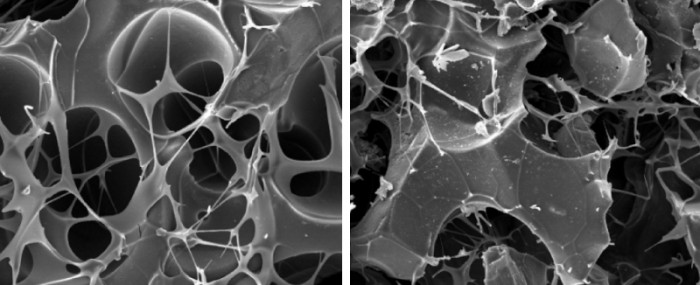
For this process to occur, the microarchitecture of the biomaterials must be regulated to have pores of sizes and connections that allow blood vessels and cells to enter and nutrient exchange to occur. Properties such as stiffness and strength must also be considered to ensure compatibility with bone. Laboratory production methods and 3D printing control all of this.
In the experiments described in the study, which were supported by FAPESP (projects 20/12954-2 and 18/18890-6), the team used biomaterials with different formulations to promote fracture regeneration in the tibiae of 16 male rats. All types of scaffolds showed significant bone recovery rates, with graphene performing best.
The researchers expect the approach to be useful for treating fractures and reconstructing bone loss or congenital bone malformations. To this end, they plan to combine the biomaterials with stem cells, such as those derived from deciduous (baby) tooth pulp. The team is also testing this method.
“Combining stem cells with biomaterials accelerates bone formation by orchestrating vascularization and tissue integration, making the process more efficient and biologically intelligent. We aren’t replacing tissues, but rather teaching the body to regenerate them,” explains the author of the study.
The article “Structural and biological characterization of carbon–graphene biomaterials derived from black liquor with functional properties for bone tissue engineering” can be read at nature.com/articles/s41598-025-29606-x.