
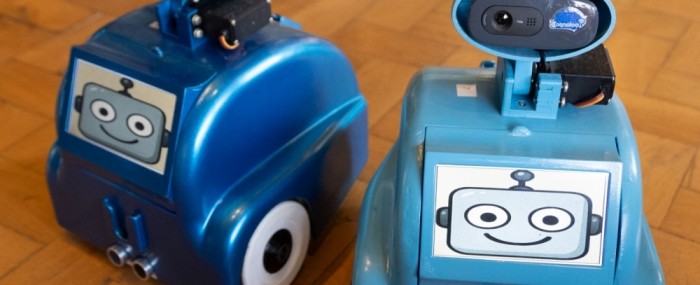
Robot turns math classes into play
27 de janeiro de 2026By Roseli Andrion | FAPESP Innovative R&D – Math can be scary. For many children, the abstract nature of numbers and operations makes them seem distant from reality. Data confirms this challenge: In Brazil, only 51% of fifth-grade public school students demonstrate adequate learning in math, according to the country’s Basic Education Assessment System (SAEB). The 2018 Program for International Student Assessment (PISA) revealed that 68.1% of young Brazilians are at the lowest level of proficiency in mathematics.
In this scenario, the Titi robot emerges as an ally, “gamifying” the teaching of mathematics and computational thinking for children in grades one through five of elementary school. The project, developed by the startup Cognology, is the result of researcher Débora Regina Ito’s concern during her volunteer work in public schools: How can we spark a genuine interest in learning among children accustomed to intensive screen use?
How it works
Titi is integrated into a tablet app through which children access games aligned with the National Common Core Curriculum (BNCC). Teachers select the desired mathematical skill and corresponding game. “The purpose of the robot is to transform the abstract into the concrete,” Ito summarizes. The solution comes with teaching materials to guide class activities.
Activities are carried out in groups of three to encourage collaboration, alternating between competitive and cooperative games. In one activity, students use a virtual ruler. They roll a digital dice and move the physical robot forward or backward to perform addition or subtraction. The robot also moves virtually on a map displayed on the tablet, making the results of the operations visible and tangible.
Currently in its third software version, the robot helps educators identify learning gaps. “Children express their difficulties more easily and talk more freely about their questions,” says the founder. The system generates reports indicating which students need special attention, enabling personalized pedagogical interventions.
Engagement and adaptation
According to the BNCC, resources such as abacuses, games, and computer programs can help students understand mathematics. Titi falls into this category by making concepts tangible. “When the robot arrives in the classroom, the children become totally devoted to it,” Ito describes.
The product’s trajectory illustrates the need for constant technological adaptation. Initially, Titi used physical mats before evolving to integrate with cell phones. However, legislation restricting smartphone use in classrooms led the team to transition to a tablet-based platform. Consequently, the mats were replaced by digital maps, reducing production costs and increasing the versatility of the tool.
Although Titi was developed with a focus on public schools, it is currently only available in private institutions. “We haven’t been able to enter public schools yet,” laments the entrepreneur. The current strategy is to establish a strong presence in the private sector first, so that in the future, the company can navigate the bureaucracy of bidding processes and approvals in education departments. “Our dream is to sell to public schools because we think that’s where we can make a difference,” Ito says.
Cognition and institutional support
The name Cognology comes from “cognition” and reflects the goal of accelerating learning. “We believe that if technology is included in children’s lives as play, they’ll be prepared to learn something bigger later,” explains the researcher, noting that future professions will require digital fluency from an early age.
Incubated at the São José dos Campos Technology Innovation Park, Cognology has received support from FAPESP through the Centelha program. Centelha is a national initiative of the Brazilian Innovation Agency (FINEP), which is linked to the Ministry of Science, Technology, and Innovation. Its mission is to stimulate innovative entrepreneurship and disseminate this culture among young people. In São Paulo, Centelha is managed by FAPESP.
The robot, originally named Teachbot, was renamed Titi after teachers suggested the original name was difficult for children to pronounce.
The founder sees potential for internationalization, noting similar challenges in other countries. At an education fair in the United States, Ito learned that American teachers face problems of technological fragmentation. Titi aims to consolidate scattered solutions into a single, integrated platform.
Digital skills and teaching challenges
In December 2023, the Brazilian Congress approved the inclusion of digital skills, such as programming and robotics, in the Law of Guidelines and Bases for Education (LDB). This measure requires that robotics education be included in elementary and high school curricula, thereby strengthening the legal support for educational technology initiatives.
However, effective implementation still faces obstacles in terms of infrastructure and teacher training. Documents from the National Council of Education Secretaries (CONSED) indicate that schools require adjustments and qualified professionals to implement the aspects of the BNCC that involve technology. In addition to operating tools, educators must be prepared to foster critical thinking among students in the context of technological advances, such as generative artificial intelligence.